Volume one · cleaning between the teeth
A water flosser is an aid, not an upgrade
A jet at the gumline, in section
Drawn for this almanac. Not to scale, and not a picture of your mouth.
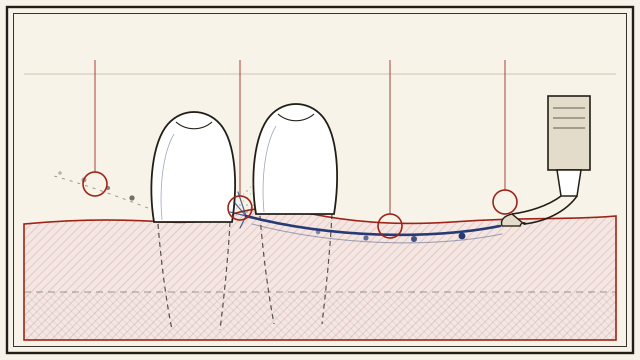
The four marks on Plate I
- The nozzle. A tip on a handle, held at the gumline rather than pushed between the teeth.
- The jet. Pulses of water running along the margin. It moves loose debris; it does not scrape anything off.
- The gap. The surface a brush cannot reach — the reason anything goes between the teeth at all.
- What leaves. Loosened debris, flushed clear. Hardened tartar is not in this picture; that needs a scaler.
An almanac of cleaning between the teeth — what the machines publish about themselves, what the trials actually found, and where home care stops and a dentist begins. Written from named sources. Read by nobody clinical.
How far the evidence reaches
Cochrane, 2019 — 35 trials, 3,929 adults. Filled bars mark the terms the review’s own sentence reaches: short, then medium.
“may reduce gingivitis in the short and medium term”
“may reduce gingivitis and plaque in the short term”
“may reduce gingivitis in the short term, but there was no evidence for this in the medium term”
“limited and inconsistent”
The review’s own verdict on all of it: “The evidence is low to very low-certainty. The effects observed may not be clinically important.” Most outcomes were measured over short periods, in people who mostly started with little gum inflammation. That is the honest state of this field, and it is why nothing on this site prints a percentage as a finding.
The entries
All of them →Can a Water Flosser Remove Tartar? Limits, Risks and Sharing
No. Once plaque hardens into tartar, only a dentist or hygienist can remove it. What a water flosser can do, where it can hurt, and sharing one.
Read the entryOct 26, 2026Waterpik Aquarius (WP-660), Read From the Manual
Ten settings, seven tips, a 22-ounce tank and a three-year warranty at $99.99 list: what Waterpik commits to, and what owners run into.
Read the entrySep 23, 2026What a Deep Clean Costs
We will not quote you a national average, because no free primary source publishes one. Here is how the billing is actually shaped, and how to get your own number in writing.
Read the entrySep 22, 2026Laser Gum Treatment
There is a professional consensus statement on this. We could not open it — so this entry tells you where it is and what to ask, and quotes none of its conclusions.
Read the entrySep 21, 2026What Home Care Can and Cannot Fix
Early gum disease is often reversible at home. Hardened calculus below the gumline is not, at any price, with any device — and the line between them is the most useful thing on this site.
Read the entryAn almanac is a book of recurring things: when to plant, when to prune, what the season asks of you. This one keeps a single small subject — the half-inch between two teeth, and the arguments people have about how to clean it.
Start here, and spend nothing
The whole of the agreed advice fits in a sentence, and it is cheap. Brush twice a day for two minutes with a fluoride toothpaste, and clean between your teeth once a day. That is the American Dental Association's home-care guidance and the National Institute of Dental and Craniofacial Research's prevention advice, arrived at separately and saying the same thing. Whether the cleaning between is done with floss, with interdental brushes or with a jet of water matters far less than whether it is done at all — the ADA's own position is that the best method is the one a person will actually keep performing.
If you want the longer version of that argument, with the trial figures and the manufacturers' claims weighed against each other, it is on the page comparing the machines.
What this almanac will not do
It will not tell you what is happening in your mouth. Bleeding gums have several explanations and they are told apart by examination, measurement and sometimes radiographs, none of which a web page performs. There is no dentist behind this masthead — nobody clinical has reviewed a word of it — and rather than hire a badge we have made that the first thing every page says.
It will also not print a number it cannot stand behind. Where two sources disagreed about a machine's pressure and the manufacturer published nothing, we left the column empty. Where a review graded its own evidence low to very low certainty, we quoted that grade instead of the flattering half of the sentence above it. There are no test results here, because we have tested nothing.
Where the ground is firm, and where it is not
Three things are well established and worth acting on. Early gum disease is often reversible with daily brushing and cleaning between the teeth. Hardened deposits below the gumline are not removable at home and need instruments in a surgery. And smoking is, in the NIDCR's words, the most significant risk factor for gum disease there is.
Everything about which between-the-teeth device wins is far softer ground. The entries work through it one question at a time — flosser against floss, what the four-week trials really showed, what to do when the machine furs up, when children can use one, and where a home routine stops being enough.